Mausoleum of Arystan Bab
Mausoleum of Arystan Bab
A Sufi sanctuary in southern Kazakhstan, the Mausoleum of Arystan Bab draws pilgrims from across Central Asia to honor the spiritual master of Khoja Ahmed Yassawi, before continuing on to Turkestan.
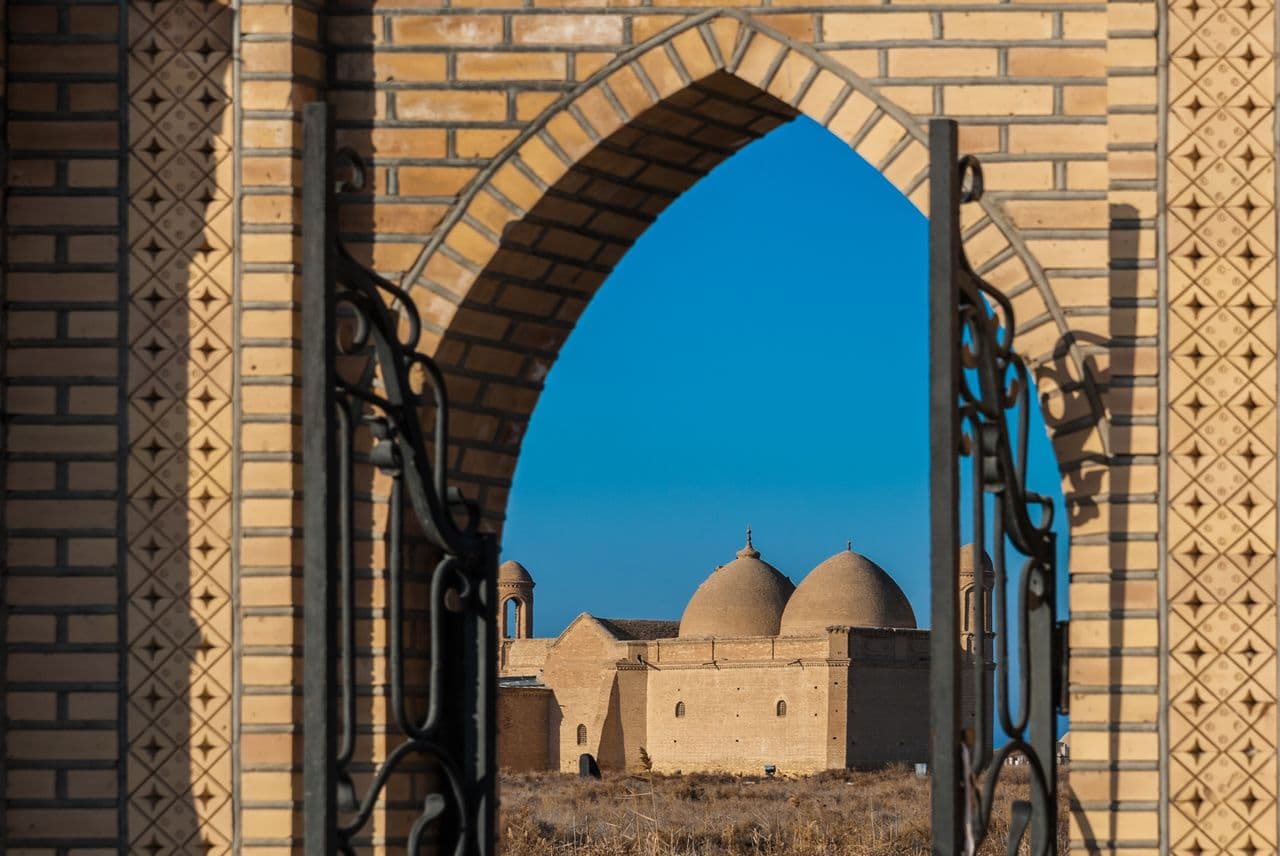
The Mausoleum of Arystan Bab stands in the arid plains of southern Kazakhstan, near the archaeological site of Otrar. This sanctuary houses the tomb of Arystan Bab, a legendary Sufi master and, according to tradition, the spiritual mentor of the poet-saint Khoja Ahmed Yassawi. For millions of Kazakh and Central Asian pilgrims, a visit here must precede the pilgrimage to Yassawi's mausoleum in Turkestan: one first asks permission from the master before paying homage to the disciple.
Essential Information at a Glance
- Entrance: free (public pilgrimage site)
- Dress code: modest attire required; women must cover their head indoors
- Shoes: must be removed before entering the tomb chamber
- Suggested duration: 30 to 60 minutes
- Access: by car from Turkestan (approximately 60 km northwest); no regular public transport
What You'll See
The current complex is a twentieth-century reconstruction built upon much older foundations. The ensemble includes an ornate entrance portal adorned with blue-turquoise ceramic tiles, an interior courtyard, a prayer hall, and the actual burial chamber. The architecture follows Timurid conventions: ribbed dome, epigraphic ceramic decoration, and pointed arches.
History and Context
Arystan Bab is a figure from the ninth to tenth centuries, supposedly a companion of the Prophet according to certain local traditions, and a transmitter of Sufi blessing to Khoja Ahmed Yassawi. His tomb is mentioned in medieval sources related to the city of Otrar, a thriving settlement on the Silk Road before its destruction by the Mongols in 1218–1219. The site has undergone several restorations, notably during the Soviet era and following Kazakhstan's independence.
Highlights of Your Visit
The Burial Chamber
The heart of the sanctuary: a simple room where Arystan Bab's cenotaph rests, draped in embroidered fabrics. Pilgrims recite prayers, touch the tomb, and leave offerings. The atmosphere of reverence is particularly striking during weekdays in low season.
The Ceramic Portal
The pishtaq (monumental gateway) concentrates the essential architectural decoration: geometric interlacing and Quranic inscriptions in blue and white tiles, characteristic of Central Asian style.
The Courtyard and Sacred Trees
In the courtyard, ancient trees are tied with colorful ribbons by pilgrims—a syncretic practice blending Islam with pre-Islamic beliefs of the Kazakh steppes.
Etiquette and Visiting Rules
- Remove your shoes before entering the tomb chamber.
- Women must cover their head and shoulders; a scarf is sufficient.
- Speak in a low voice; the site remains active for prayer throughout the day.
- Ask permission before photographing pilgrims at prayer.
- Avoid turning your back to the tomb when leaving the burial chamber.
Photography Tips
Morning light is ideal for photographing the ceramic portal, which faces east. The interior of the burial chamber is dimly lit: a bright lens is helpful. Photography is permitted in the courtyard and on the portal; indoors, first observe whether pilgrims object to it.
Location and Access
The mausoleum is located in the village of Otrar Tobe, approximately 60 km northwest of Turkestan. The road is paved but lightly traveled. The most practical solution is to rent a taxi or vehicle from Turkestan for a half-day trip combining both sites. No regular bus service is confirmed. The terrain around the mausoleum is flat and accessible, though the interior has high thresholds.
Nearby
- Mausoleum of Khoja Ahmed Yassawi (Turkestan) — a Timurid masterpiece listed by UNESCO, an essential stop on the same pilgrimage circuit.
- Archaeological Site of Otrar — ruins of one of the great medieval cities of the Silk Road, a few kilometers from the mausoleum.
- Otrar Museum — collections of artifacts from the city's excavations, to contextualize your visit to the site.
Häufig gestellte Fragen
Entrance is free. The site is a public pilgrimage place open to all.
Modest attire for everyone. Women must cover their head and shoulders indoors. Shoes are removed before entering the burial chamber.
Yes, and this is indeed the traditional pilgrimage practice: visit Arystan Bab first, then Yassawi. The two sites are approximately 60 km apart and can be combined in one day by car.
The most reliable solution is a taxi or rental vehicle from Turkestan. Plan to negotiate a round trip with time to spend on site.
Spring (April–May) and autumn (September–October) offer pleasant temperatures. Summer is very hot in this semi-arid region. The site is active year-round, with peaks in attendance during Islamic holidays.
It is generally permitted in the courtyard and on the portal. Inside the burial chamber, ask for permission and avoid photographing pilgrims at prayer without their consent.
Interesse an diesem Besuch?
Wir können ihn in Ihre persönliche Route aufnehmen.